
How Much Does Epoxy Floor Coating Cost?
Quotes for an epoxy floor can vary widely from one person to the next, usually because each one covers a different amount of work. Below, you will find the parts of a professional estimate, the reasons each factor moves the price, and the items a thorough proposal should name.

The Short Answer
To set a budget, it helps to know that professionally installed epoxy floor coatings often land in the $6–$10 per square foot range. Working from $8 as the midpoint, an ordinary two-car garage comes to about $3,200–$4,000. What your own project costs depends on the floor's size, the prep the concrete requires and the coating system that fits the space, and those details only become dependable after an in-person evaluation.
What Affects the Cost?
When epoxy coating proposals differ, five factors explain most of the gap.
01
Floor Size
More floor means more material and more labor. Certain costs, however, stay nearly the same regardless of square footage, such as transporting equipment, setting up and getting started. Across a big slab, that overhead becomes a smaller share of the total; on a small one it counts for more. Accurate measurements give an estimate a solid base.
02
Concrete Condition
Oil-saturated spots, leftover sealers, cracking across the slab or a badly worn surface each add prep before coating can start. Concrete that is structurally sound and has never been sealed takes far less work before it is ready for coating.
03
Surface Preparation
Grinding opens up the concrete and produces the texture coatings grip. The slab determines how much of it is needed, since hard-troweled surfaces, damage and existing coatings all widen the scope. An estimate that accounts for genuine prep shows the real cost of a floor meant to perform.
04
Coating System
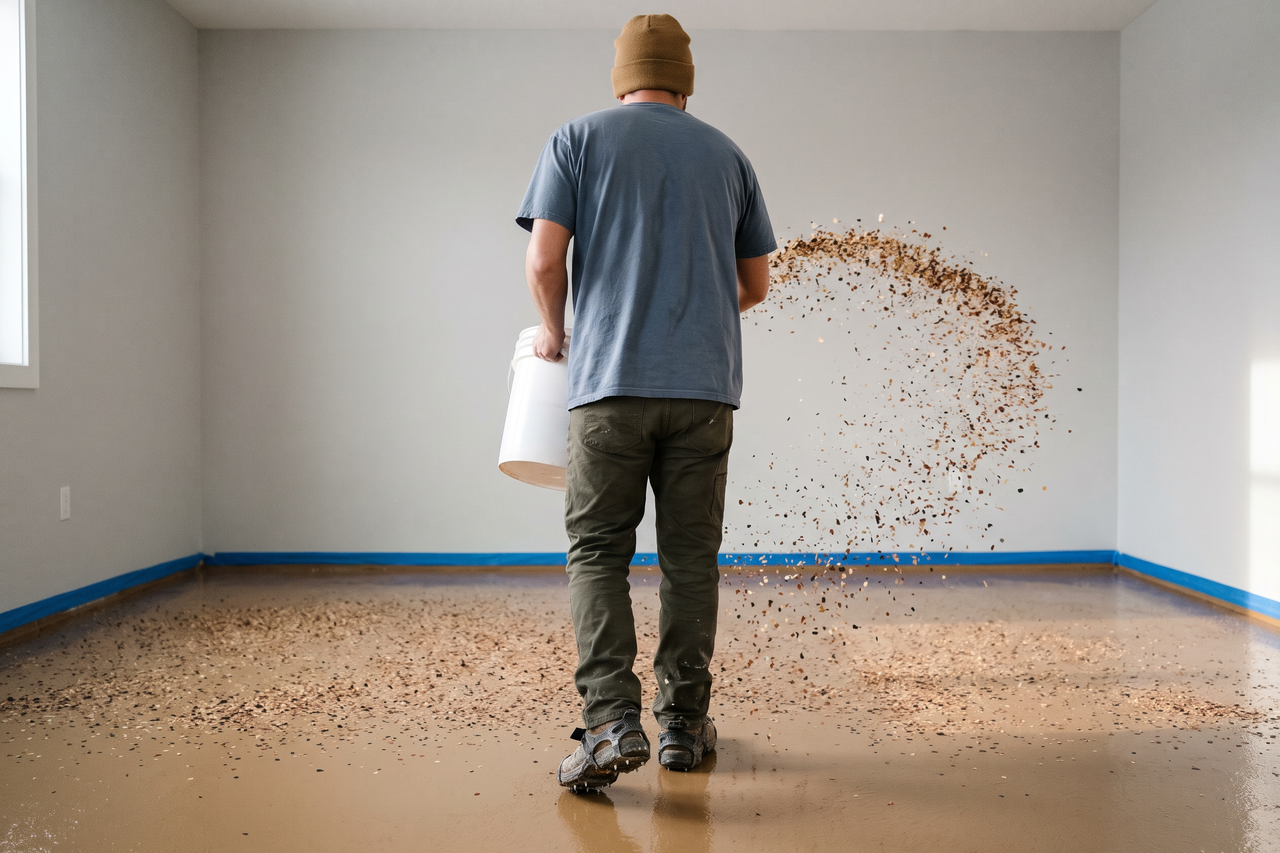
A one-coat application falls at the low end on materials. Multi-layer builds use substantially more product, putting primer under a high-build base, then flake and a urethane or polyaspartic topcoat on top. The right build follows from the slab’s condition and what the space requires, not from a stock package.
05
Decorative Finish
Solid color is the easiest decorative option to install and the most affordable. Flake systems involve extra material and labor in exchange for a speckled, textured appearance. Metallic finishes call for specialized skill and carry the highest decorative price.
What Are You Really Paying For?
For a stage-by-stage view of a professional coating job and the reason behind each step, see our guide to how installation works.
An estimate pays for the whole job: the labor to prep and apply, grinding machines and their consumables, commercial-grade coatings and the experience needed to choose a system for that particular slab. Materials are only a slice of the price.
If one quote lands well below the others, it makes sense to ask what was dropped. Thinner grinding, a coat or two less, or cracks left alone mean a reduced scope, not an identical job at a lower rate. Setting proposals side by side, item against item, shows what each one really includes.
Trimming prep, coats or repairs lowers the number because there is simply less work, and that difference usually becomes visible in the floor as it ages.
How Much Does a Garage Floor Cost?
Here is what the $8 planning figure looks like when applied to familiar garage sizes, as a rough budget guide.
| Garage | Floor Area | Planning Figure |
|---|---|---|
| Single-bay | 250 sq ft | $2,000 |
| Two-bay, standard | 400 sq ft | $3,200 |
| Two-bay, oversized | 500 sq ft | $4,000 |
| Three-bay | 750 sq ft | $6,000 |
Note: every number in this table is the floor area times an $8 planning rate, a point in the $6–$10 band that professional work usually falls into. Treat them as budgeting figures, not quotes. Your real price hinges on what condition the concrete is in, the amount of prep required and the coating system selected, and nobody can pin it down until the floor has been evaluated in person.
Is It Worth the Cost?
Consider a normal stretch of garage life: cars pulling in and backing out, drips under the engine, a wrench hitting the floor, a mower or toolbox dragged over a slab that was never designed to look good for long. A bare slab soaks up every bit of it.
Raw concrete is porous. Spills sink in and leave stains, discoloration spreads with use, and the surface wears down under physical stress. A coating laid over concrete that was not correctly profiled may not bond dependably, and it can lift or peel, which leaves the owner paying for the floor twice.
A coating picked for the real conditions in the room is far better than bare concrete at holding spills on the surface, where a rag can deal with them. Garages, workshops and utility rooms gain the most, since looks and easy cleanup count there.
What Should Be Included in Your Quote?
A complete proposal describes the entire project, not only the coating material. As you read through a written proposal, make sure it addresses each of these points:
- Slab evaluation — moisture testing and an in-person review of the concrete before the work is planned
- Surface profiling — shot blasting or diamond grinding so the slab has the tooth a coating grips
- Crack and spall repair handled while the concrete is still uncoated
- Primer choice guided by the slab’s moisture results and how porous the concrete is
- Base coat and broadcast — pigmented layer plus any flake, installed the way the chosen system calls for
- Topcoat application sized for the wear and exposure that slab will see
- Site cleanup of grinding dust and prep debris, plus removal of waste
- Cure-stage guidance explaining which uses the floor can take at each point once the last coat is on
If a written proposal leaves out anything on this list, ask the contractor to explain how it is covered before you sign.
Frequently Asked Questions
Q: Why do epoxy floor quotes vary so much between contractors?
Scope explains most of the difference. A proposal with lighter prep, fewer coats or nothing set aside for cracks covers less work, and the lower number reflects that, not a smarter process. Comparing proposals line by line reveals what each actually covers.
Q: Does a larger floor usually cost less per square foot?
Frequently. Startup costs like transporting equipment and setting up the site stay the same as the floor gets bigger, so on a large slab they are divided across more square feet. On a smaller floor they take up a larger portion of the total.
Q: Can I use the $6–$10 range for an early budget?
Yes, as a starting point. Run the garage table above at the $8 midpoint and the result is a ballpark figure driven only by size. The range cannot account for your slab’s condition, its prep needs or the system that suits it, so a meaningful number has to wait for an in-person look at the floor.
Q: Can the state of the concrete make a big difference to the price?
Sometimes a great deal. Significant repairs, removing an old coating or widespread patching all add labor and materials before any coating can go on. When a slab has serious problems, prep can represent a sizable part of the estimate.
Q: Are there costs a flooring proposal typically leaves out?
Clearing out cars, tools and stored items before work starts usually falls to the owner. Work on structural slab defects, drainage corrections and repairs unrelated to the coating is not normally part of a standard flooring proposal.
Q: What usually explains a higher estimate?
A higher figure often points to a fuller scope, like extra coats, better-grade materials or a system designed for harsher conditions. A price tag proves nothing by itself, so ask what the figure covers and why that system fits your floor. A clear, detailed answer suggests the recommendation was thought through.
Ready to Get a Real Number for Your Floor?
Serving Kirksville, MO and surrounding areas. Give us a picture of your floor and request a customized quote that reflects the work your concrete truly calls for.